

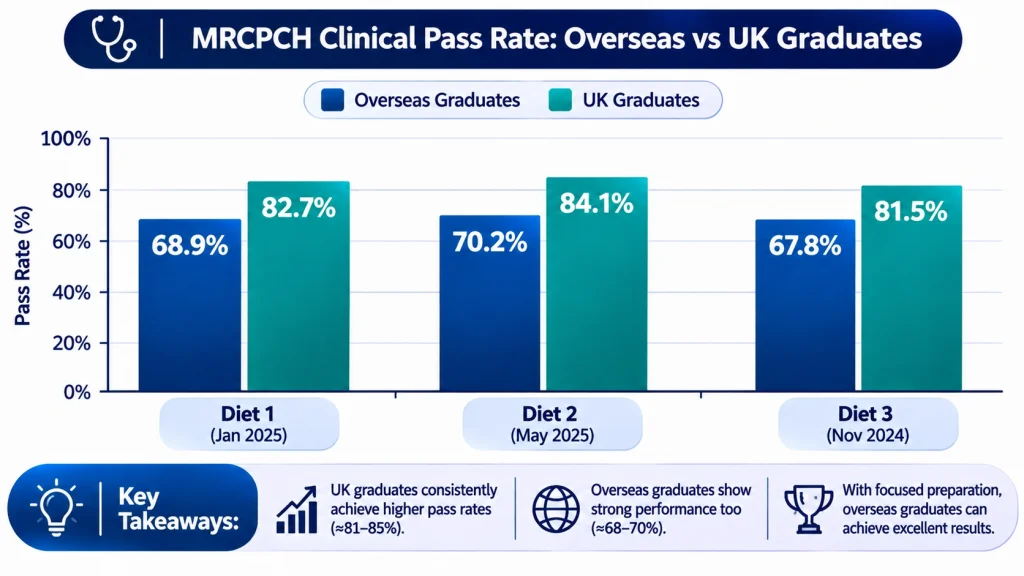
The MRCPCH Clinical pass rate for overseas graduates was between 52.4% and 58.0% in the last three published diets, against 90.6% to 95.1% for UK graduates. That gap is real and consistent, but it is not a verdict on your ability: treat it as a signal about what to prepare differently.
This guide covers the published figures, what the gap might mean for you, how to prepare for a UK-style clinical assessment and a 12-week plan you can adapt.
Table of Contents
MRCPCH Clinical pass rate: the published figures
RCPCH publishes the Clinical pass rate for each diet, split into four groups: overall, UK graduates, overseas graduates and UK workers. The table below shows the three most recent diets exactly as published on the RCPCH exam results page.
| Diet | Overall (%) | UK graduates (%) | Overseas graduates (%) | UK workers (%) |
| 2026.2 | 65.5 | 95.1 | 54.4 | 68.4 |
| 2026.1 | 68.3 | 90.6 | 52.4 | 71.1 |
| 2025.3 | 68.8 | 94.6 | 58.0 | 73.5 |
In each of these diets, the gap between UK graduates and overseas graduates was between 36.6 and 40.7 percentage points. RCPCH labels “overseas graduates” as graduates of non-UK medical schools, and the table does not separate candidates from India, the Gulf or any other country, so treat any country-specific figure you see elsewhere with caution.
Candidate numbers are not shown here, and RCPCH publishes figures going back further, but only these diets were checked for this guide. For the full results process, including timings, see our MRCPCH results guide.
How the theory results compare
The theory picture is very different, and it is worth knowing before you plan. At TAS and AKP, overseas graduates had higher pass rates than UK graduates in each of the last three diets.
| Exam and diet | UK graduates (%) | Overseas graduates (%) |
| TAS 2026.2 | 41.0 | 65.2 |
| TAS 2026.1 | 56.9 | 76.8 |
| TAS 2025.3 | 43.7 | 72.6 |
| AKP 2026.2 | 50.0 | 68.8 |
| AKP 2026.1 | 47.6 | 66.6 |
| AKP 2025.3 | 65.9 | 71.1 |
These figures suggest that theory knowledge alone may not explain the Clinical gap, although RCPCH does not say why it exists. If you passed the theory exams well, the task for the Clinical is to show that knowledge in the way the exam assesses it, in front of trained examiners.
Why the gap might exist: possibilities to check in yourself
RCPCH does not publish a reason for the difference, so nobody can tell you the cause with certainty. What we can do as mentors is offer possibilities and suggest you test each one against your own practice. Treat these as a self-audit, not as facts about any group.
Consultation style may be one factor worth examining. If your daily work involves short outpatient consultations where the doctor leads and the family listens, a UK-style approach, where you explore the parent’s concerns, check understanding and agree a plan together, may feel unfamiliar under exam pressure. Ask a colleague to watch you take a history and tell you honestly how much space you give the parent.
Structured examination is another area to check. In busy wards, you might examine efficiently but out of order, or skip the commentary that shows an examiner your reasoning. Practise presenting findings in a clear sequence and linking them to a sensible differential.
Exposure to feedback may also play a part. Doctors who have rarely been observed and scored on a consultation may not know where they lose marks. Finally, language and phrasing can matter even for fluent English speakers: RCPCH does not require an English test but recommends a level equivalent to IELTS 7, and plain explanations to parents, without jargon, are a skill worth rehearsing on their own.
How to prepare for a UK-style Clinical
The best preparation for the Clinical is observed practice with honest feedback, repeated until your structure becomes automatic. Reading alone is unlikely to be enough if you already know the medicine.
Start by learning how the exam is run. RCPCH describes it as a circuit of 10 scenarios or stations in a hospital, with trained examiners at each station, and details are on the RCPCH Clinical exam page. Our MRCPCH Clinical exam guide explains the format in more depth. Station-by-station content is not something we will guess at here, so build broad skills rather than memorising scripts.
Focus your practice on four areas:
- Communication: open questions, exploring ideas, concerns and expectations, explaining in plain words and checking understanding.
- Structured examination: a consistent routine for each system, with a short, confident summary of findings.
- Practice with feedback: sessions where someone scores you against a marking structure and tells you exactly what to change.
- UK-style consultation: shared decisions, safety-netting advice and a clear plan the family can follow.
If you want guided practice, StudyMRCPCH has an MRCPCH Clinical course; see the course page for what it includes. You can also look at StudyMEDIC’s clinical programme in paediatrics.
A 12-week Clinical plan
A 12-week plan works well once you have your theory passes and a realistic exam date. Adjust the pace to your rota, but keep weekly observed practice from the first week.
| Weeks | Focus | What to do |
| 1 to 2 | Baseline | Read the RCPCH Clinical information, record or be observed in two consultations, list your weak areas honestly |
| 3 to 4 | History and communication | Daily practice with a partner on parent-led histories, explaining a diagnosis and checking understanding |
| 5 to 6 | Structured examination | One system per few days, same routine every time, present findings aloud in under two minutes |
| 7 to 8 | Integration | Combine history, examination and explanation in timed cases, with written feedback after each |
| 9 to 10 | Mock circuits | Full timed circuits with senior colleagues scoring you, then fix the two lowest scores |
| 11 to 12 | Polish and logistics | Light practice, admission letter checks, travel and rest, no new material |
The plan assumes you meet the RCPCH recommendations for the Clinical, which “strongly recommends” at least 2.5 years of training from the graduation date on your medical degree and at least 12 months in posts involving acute paediatric care in the five years before the exam. These are recommendations rather than rules, but it is wise to take them seriously when you pick your exam date. Our MRCPCH eligibility guide covers the details.
Timing, attempts and the pass mark
Knowing the scoring and attempt rules helps you plan when to sit, not just how. The MRCPCH Clinical pass mark is 62 out of 82, and a score of 52 or below means you cannot sit the next diet, so sitting before you are ready can cost you more than one diet.
| Rule | What RCPCH says |
| Pass mark | 62 out of 82 |
| Low score | 52 or below means you cannot sit the next diet |
| Attempts | Up to 6 at each component, counted from 1 September 2024 |
| Extra attempt | From 1 November 2026, one further attempt may be allowed with evidence of additional educational experience |
| 7-year rule | Pass the Clinical within seven years of passing all three theory exams |
| Results | In your online account six to seven weeks after the exam |
An attempt counts once you start the exam. Places at overseas centres are allocated by priority rather than first come, first served, and RCPCH notes high demand in India and the Middle East, so read our guide to MRCPCH Clinical centres in India and the Gulf before you apply. With waits possible, the MRCPCH Clinical pass rate matters less than making each attempt a well-prepared one.
What this means for your plan
The figures tell you where to put your effort, not whether you will pass. Overseas graduates had higher pass rates than UK graduates at TAS and AKP in the last three diets, so if you are one of them, your biggest gains may come from observed practice, structured examination and a calm, parent-centred consultation style.
Be honest with yourself after each practice session. If the same feedback keeps appearing, such as running out of time or not checking understanding, fix that one habit before adding anything new. A clear plan for the whole journey is in our MRCPCH preparation guide.
Frequently asked questions
What is the MRCPCH Clinical pass rate for overseas graduates?
In the last three published diets, overseas graduates passed the Clinical at 52.4% to 58.0%. UK graduates passed at 90.6% to 95.1% over the same diets.
Does RCPCH publish a pass rate for Indian or Gulf candidates?
No. The published table separates UK graduates, overseas graduates and UK workers, but not individual countries, so any country figure would not come from RCPCH.
Why do overseas graduates pass the theory exams at higher rates than the Clinical?
RCPCH gives no reason. One possibility worth checking in yourself is that the Clinical rewards a UK-style consultation and structured presentation, which knowledge alone does not provide.
What is the MRCPCH Clinical pass mark?
The pass mark is 62 out of 82. A score of 52 or below means you cannot sit the next diet.
How many times can I sit the MRCPCH Clinical?
You can make up to 6 attempts, counted from 1 September 2024. From 1 November 2026, one further attempt may be allowed if you show evidence of additional educational experience since your last attempt.
How long should I prepare for the Clinical?
A focused 12-week block, as in the plan above, is a sensible starting point once your theory passes are in place. Start observed practice with feedback in week one rather than leaving it to the end.
Talk to our MRCPCH team at StudyMRCPCH, or see the MRCPCH Clinical course page for what it includes.
Related guides:
- MRCPCH Clinical exam: format, pass mark and preparation
- MRCPCH results: timings and pass rates
- MRCPCH Clinical centres in India and the Gulf
- MRCPCH eligibility explained
Sources: