
Your career after MRCPCH depends less on the letters themselves and more on where you want to work, because each country’s regulator decides what the qualification counts for. RCPCH says MRCPCH is the normal entry requirement for specialty paediatric training in the UK, while in India and the Gulf you need to check how the national regulator treats it before you plan a job move around it.
This guide covers what MRCPCH does and does not do, the UK, India and Gulf picture, how doctors use it within local training, and how to plan your timeline.
Table of Contents
What MRCPCH does and does not do for your career
A career after MRCPCH starts with understanding that the qualification shows you have passed a demanding set of paediatric exams, not that you are automatically licensed anywhere. MRCPCH is membership of the Royal College of Paediatrics and Child Health (RCPCH), earned by passing three theory exams (FOP, TAS and AKP) and the MRCPCH Clinical exam. RCPCH says UK trainees usually sit it during core paediatric training, and that trainees outside the UK may take it for up-skilling or as part of local training.
What it does not do is replace registration or licensing. Every country has its own regulator, and each one decides which qualifications it accepts, for which job titles, and with what conditions. That is why the honest answer to “what can I do with MRCPCH?” is always “it depends on the country”, followed by a list of who to ask.
Thinking about your career after MRCPCH this way protects you from expensive mistakes. A paediatric career plan built on a forum post can fall apart at the licensing stage; one built on the regulator’s current rules usually holds up.
Working in the UK after MRCPCH
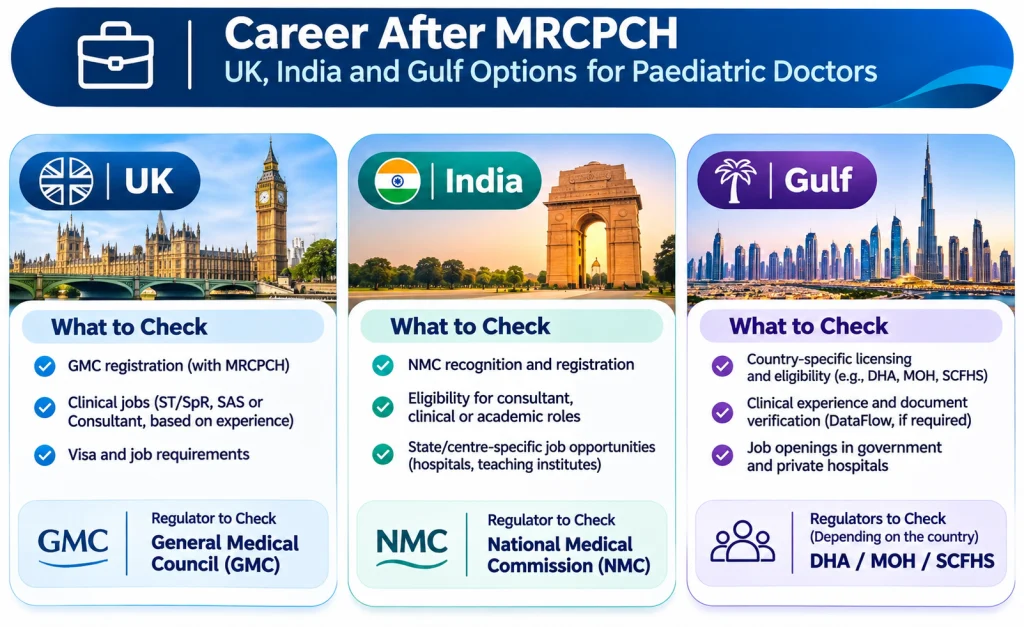
For a career after MRCPCH in the UK, the key fact is that RCPCH describes MRCPCH as the normal entry requirement for specialty paediatric training. That makes it a central step if you are aiming for a UK training post. UK trainees usually sit the exams during core paediatric training, so if you are applying from India or the Gulf you are working towards the same qualification UK colleagues use to progress in their paediatric career.
Registration with the General Medical Council (GMC) is a separate process from passing the exams. The exams themselves require a primary medical qualification acceptable for GMC registration, but passing MRCPCH does not register you. Check the GMC’s current requirements and the current recruitment rules for any post you apply for, because those details change and are outside what RCPCH’s exam pages cover.
For doctors thinking about the UK, a realistic career after MRCPCH plan has two parallel tracks: the exams, and the registration and job application process. Starting both early, rather than one after the other, tends to save time.
Career after MRCPCH in India
Working in India needs careful checking, because MRCPCH is not, on its own, listed as equivalent to MD or DNB Paediatrics in India; check the NMC’s current rules before relying on it for jobs or teaching posts in India. The National Medical Commission (NMC) says it “does not process individual applications for equivalence” of a foreign medical qualification, and refers to the NMC (Recognition of Medical Qualification) Regulations, 2023. MRCPCH is not named on that NMC page.
Teaching posts follow separate rules. As reported by Medical Dialogues in July 2025, the Medical Institutions (Qualifications of Faculty) Regulations, 2025 set out a UK route to equivalence for teaching posts that needs a Certificate of Completion of Specialist Training (or equivalent training) plus a final FRCP or FRCS, and registration to practise the specialty. MRCPCH and other membership exams are not mentioned in that report.
None of this means MRCPCH has no value in India. RCPCH says trainees outside the UK may take it for up-skilling or as part of local training, and some doctors also see it as a step towards a paediatric career abroad. For a fuller comparison with Indian postgraduate routes, read our guide to MRCPCH vs MD and DNB Paediatrics.
The UAE and other Gulf countries
In the UAE, the unified Professional Qualification Requirements (PQR) list UK Royal College membership or fellowship among recognised UK qualifications, with conditions, and grade qualifications in tiers that decide whether you can be licensed as a Specialist or Consultant. Check the current PQR and your licensing authority (DHA, DOH or MOHAP) before you plan a move. MRCPCH is not named in the part of the document we checked, so do not assume a particular tier or title for it.
For Qatar, Saudi Arabia, Oman, Kuwait and Bahrain, check the regulator’s current requirements before you plan a career after MRCPCH there. RCPCH runs MRCPCH Clinical exams in Doha, Jeddah and Muscat, but that is an exam-venue fact, not a statement about licensing or recognition. Keep the two separate in your planning. This table sums up what to check for a career after MRCPCH in each region.
| Where you want to work | What is confirmed | Who to check with |
| UK | RCPCH: normal entry requirement for specialty paediatric training | GMC and the relevant recruitment body |
| India | Not, on its own, listed as equivalent to MD or DNB Paediatrics | National Medical Commission |
| UAE | UK Royal College membership or fellowship listed in the PQR, with conditions and tiers | DHA, DOH or MOHAP |
| Qatar, Saudi Arabia, Oman, Kuwait, Bahrain | No recognition details confirmed here | That country’s health regulator |
Using MRCPCH within training at home
Using MRCPCH within training at home is a common route, and RCPCH itself says trainees outside the UK may take it for up-skilling or as part of local training. For doctors in India and the Gulf, the exams can give structure to their learning and to a career after MRCPCH while they keep working in their current post. The theory exams can be taken in any order, and diets run three times a year, so you can fit them around your rota.
The Clinical exam is the stage where hands-on experience matters most. RCPCH strongly recommends at least 2.5 years of training from your graduation date, and at least 12 months in posts involving acute paediatric care in the five years before the exam. These are recommendations rather than requirements, but they show the level of experience RCPCH has in mind for the Clinical.
You can also look at StudyMEDIC’s clinical programme in paediatrics. For exam preparation, StudyMRCPCH has courses for MRCPCH FOP and TAS, MRCPCH AKP and the MRCPCH Clinical exam; see each course page for what it includes.
Planning your timeline and the rules that shape it
Planning your career after MRCPCH means respecting the exam rules as well as the job rules. You must pass the MRCPCH Clinical within seven years of passing all three theory exams. If that period lapses without a Clinical pass, AKP must be re-sat and the seven years restart from the new AKP pass, although exceptions may be granted on application.
Attempts are limited too. You have up to six attempts at each component, counted from 1 September 2024, and from 1 November 2026 a candidate who has failed six times may be allowed one further attempt with evidence of additional educational experience. An attempt counts once you start the exam.
Clinical places also affect timing. Overseas centres allocate places by priority rather than first come, first served, and RCPCH says India, Pakistan, Egypt, Saudi Arabia and the UAE have very high demand. Build some slack into your paediatric career plan for this, and read our guide to the MRCPCH Clinical exam before you apply.
Choosing your next step
Choosing your next step for a career after MRCPCH comes down to three questions: where do you want to work, what does that country’s regulator accept, and what experience will you need to show? Answer them in that order. It is tempting to start with a job advert, but the regulator’s rules decide whether you can take the job at all.
If you are early in your paediatric career, focus on passing the exams in a sensible order and building acute paediatric experience. If you are further along, start talking to the regulator in your target country while you prepare for the Clinical. Either way, check your MRCPCH eligibility first, and if you are curious about later College stages, our guide to MRCPCH vs FRCPCH explains how membership and fellowship differ.
Frequently asked questions
What can I do with MRCPCH in the UK?
For a career after MRCPCH in the UK, RCPCH says MRCPCH is the normal entry requirement for specialty paediatric training. GMC registration and job applications are separate processes, so check the GMC’s current requirements.
Is MRCPCH recognised in India?
MRCPCH is not, on its own, listed as equivalent to MD or DNB Paediatrics in India. Check the NMC’s current rules before relying on it for jobs or teaching posts.
Can I work in the UAE after MRCPCH?
The UAE’s unified PQR lists UK Royal College membership or fellowship among recognised UK qualifications, with conditions and tiers. Check the current PQR and your licensing authority (DHA, DOH or MOHAP).
What about Qatar, Saudi Arabia and Oman?
Check the regulator’s current requirements in each country. Holding a Clinical exam centre there is not the same as recognising the qualification for licensing.
Does MRCPCH help if I stay in my current job?
RCPCH says trainees outside the UK may take MRCPCH for up-skilling or as part of local training. Some doctors use it to give their paediatric career more structure while they keep working.
How long do I have to finish MRCPCH?
The Clinical must be passed within seven years of passing all three theory exams. If that lapses, AKP must be re-sat and the seven years restart.
Planning your career after MRCPCH? Start with the MRCPCH FOP and TAS course page to see what it includes, or Talk to our MRCPCH team about your route.
Related guides:
Sources:
- RCPCH: About MRCPCH
- RCPCH: Exam regulations
- RCPCH: MRCPCH Clinical centres and fees
- NMC: Equivalence of foreign medical qualification
- Medical Dialogues: NMC faculty qualification regulations report, July 2025
DHA: Unified Healthcare Professional Qualification Requirements