
MRCPCH vs MD is not a straight swap: MD and DNB Paediatrics are Indian postgraduate qualifications, while MRCPCH is a UK membership earned by passing four RCPCH exams. If your career is centred on India, the Indian qualifications are the natural priority; if you want options in the UK or a credential you can build while working, MRCPCH deserves a serious look, and the two can be combined.
This guide covers how the two routes compare, what recognition looks like in India, the UK and the Gulf, who each route suits, and how to fit MRCPCH alongside or after MD or DNB.
Table of Contents
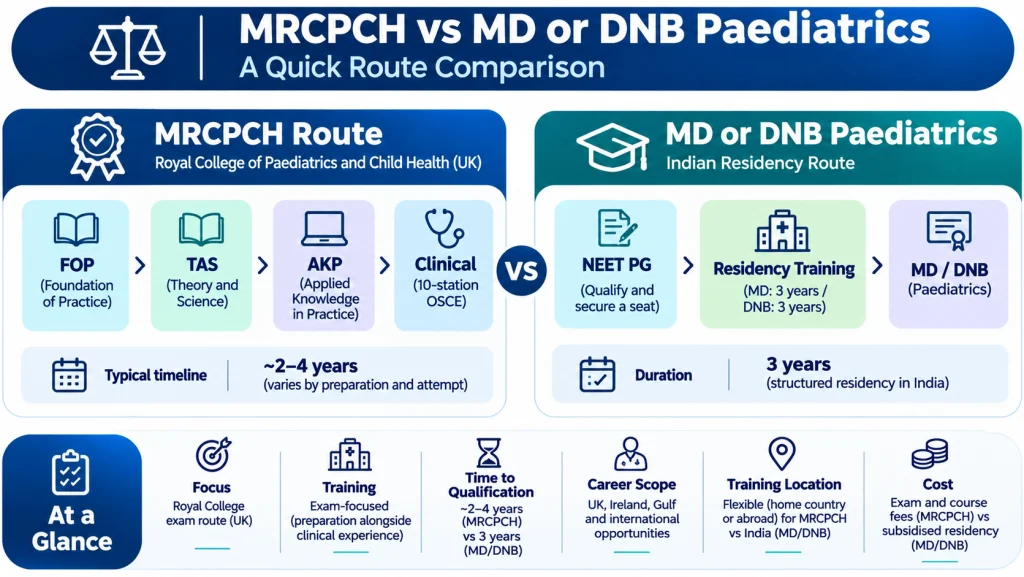
MRCPCH vs MD and DNB Paediatrics at a glance
The quickest way to weigh the two is side by side. The table keeps to what can be stated with confidence; anything not listed is worth checking with the awarding body or regulator directly.
| MRCPCH | MD Paediatrics / DNB Paediatrics | |
| Awarded by | Royal College of Paediatrics and Child Health (RCPCH), UK | Indian postgraduate qualifications |
| How you earn it | Pass four exams: FOP, TAS, AKP and the MRCPCH Clinical | Postgraduate training in India; check the Indian authorities for entry and training rules |
| Can you sit it while working? | Yes, exams are sat at test centres or hospital Clinical centres | Check the Indian authorities |
| Basic eligibility | A primary medical qualification acceptable for GMC registration | Set by Indian authorities |
| Recognition in India | Not, on its own, listed as equivalent to MD or DNB Paediatrics | Indian postgraduate qualifications |
| Use in the UK | RCPCH says it is the normal entry requirement for UK specialty paediatric training | Check UK requirements separately |
| Fees | Charged per exam in pounds sterling | Not covered here |
Two lines in that table do most of the work. MD Paediatrics and DNB Paediatrics are built for practice in India; MRCPCH is built around the UK training system but is sat by doctors around the world.
How the MRCPCH route works
MRCPCH is made up of three theory exams, Foundation of Practice (FOP), Theory and Science (TAS) and Applied Knowledge in Practice (AKP), plus the MRCPCH Clinical. The three theory exams can be taken in any order, and all three must be passed before you apply for the Clinical, which is the final component.
To sit any exam you need a primary medical qualification acceptable for GMC registration. There is no English test, although RCPCH recommends English equivalent to IELTS level 7. For the Clinical, RCPCH strongly recommends at least 2.5 years of training from your graduation date and at least 12 months in posts involving acute paediatric care in the five years before the exam. Our MRCPCH eligibility guide covers this in detail.
For doctors in India and the Gulf, the practical advantage is access. Theory exams run at test centres in Bangalore, Chennai, Hyderabad, Kochi, Kolkata, Mumbai and New Delhi, and across the Gulf in the UAE, Qatar, Saudi Arabia, Oman, Kuwait and Bahrain. Clinical exams are held at centres including Ahmedabad and Navi Mumbai, Jeddah, Muscat and Doha; there is no Clinical centre in Kuwait or Bahrain. For the full picture, start with what is MRCPCH.
What MD and DNB Paediatrics involve
MD Paediatrics and DNB Paediatrics are Indian postgraduate qualifications, awarded within the Indian system rather than by a UK college. Some readers come to this comparison after NEET-PG, but entry rules are set by Indian authorities, so check them directly.
The strength of the Indian route is that you finish with a qualification from the Indian system itself. For seat numbers, durations, training structure or fees, check the official Indian bodies directly, because those details change and are outside this guide.
Recognition: India, the UK and the Gulf
Recognition is where the MRCPCH vs MD decision really turns, so read this section carefully. In India, MRCPCH is not, on its own, listed as equivalent to MD or DNB Paediatrics; check the NMC’s current rules before relying on it for jobs or teaching posts in India.
The National Medical Commission says it “does not process individual applications for equivalence” of foreign medical qualifications and refers to its 2023 recognition regulations, as explained on the NMC equivalence page. MRCPCH is not named there. As reported in July 2025, the UK route to equivalence for teaching posts under the 2025 faculty regulations needs a Certificate of Completion of Specialist Training (or equivalent training) plus a final FRCP or FRCS, and registration to practise the specialty; membership exams such as MRCPCH are not mentioned.
In the UK, RCPCH says MRCPCH is the normal entry requirement for specialty paediatric training, and that UK trainees usually sit it during core paediatric training. Outside the UK, trainees may take it for up-skilling or as part of local training.
In the UAE, the unified PQR lists UK Royal College membership or fellowship among recognised UK qualifications, with conditions, and grades qualifications in tiers that decide whether you can be licensed as a Specialist or Consultant. Check the current PQR and your licensing authority (DHA, DOH or MOHAP). For Qatar, Saudi Arabia, Oman, Kuwait and Bahrain, check the regulator’s current requirements before you plan around any qualification.
Who each route suits
The MRCPCH vs MD choice depends far more on where you want to work than on which qualification sounds stronger. Think about the next ten years, not the next exam.
| Your situation | Route worth prioritising |
| You want to practise or teach long term in India | MD Paediatrics or DNB Paediatrics; MRCPCH can be added later |
| You hope to train in the UK | MRCPCH, alongside the UK’s own registration steps |
| You already work in the Gulf | Check your regulator first; MRCPCH may fit around your job |
| You have finished MD or DNB and want wider options | MRCPCH as an additional credential |
| You did not secure a paediatrics seat this year | Weigh another NEET-PG attempt against starting MRCPCH theory |
If India is home for the long haul, remember that MD and DNB Paediatrics are Indian qualifications, while MRCPCH on its own is not listed as equivalent to them. If the UK is the goal, MRCPCH is part of the standard training path there. For doctors already working in the Gulf, the answer depends on your licensing authority, so ask them before committing years of study. Our career after MRCPCH guide looks at these destinations in more depth.
Doing MRCPCH alongside MD or DNB, or after it
You do not have to choose one for life. Because MRCPCH is exam-based, you can sit the theory papers during or after MD or DNB Paediatrics, using the same clinical knowledge they are building on the wards.
A sensible order for a resident is to start with FOP and TAS, which are sat on the same day, then AKP once you have more clinical experience. The Clinical comes last, and RCPCH’s experience recommendations above mean it may fit best later in your training or after it. Remember the seven-year rule: the Clinical must be passed within seven years of passing all three theory exams.
If you are planning that first step, StudyMRCPCH has a course for MRCPCH FOP and TAS; see the course page for what it includes. Check the MRCPCH exam dates before you build a study plan around your rota, and the MRCPCH fees guide for current costs in pounds sterling.
If NEET-PG did not go your way
A disappointing NEET-PG rank is hard, but it does not close paediatrics to you. MRCPCH only asks for an acceptable primary medical qualification to sit the theory exams, so you can start FOP and TAS while you decide on another NEET-PG attempt.
Be honest with yourself about the trade-off. MRCPCH will not give you an Indian postgraduate degree, and on its own it is not listed as equivalent to MD or DNB Paediatrics in India. What it can give you is structured progress, a UK membership qualification if you complete all four exams, and options if your plans later point abroad. You can also look at StudyMEDIC’s clinical programme in paediatrics.
Frequently asked questions
Is MRCPCH equivalent to MD Paediatrics in India?
MRCPCH is not, on its own, listed as equivalent to MD or DNB Paediatrics in India. Check the NMC’s current rules before relying on it for jobs or teaching posts.
Which is better, MRCPCH vs MD?
Neither is better in general; it depends on where you want to work. MD and DNB Paediatrics are Indian qualifications, while RCPCH says MRCPCH is the normal entry requirement for UK specialty paediatric training.
Can I do MRCPCH during my MD or DNB residency?
Yes. MRCPCH is exam-based, so you can sit the theory exams while training, and plan the Clinical for later in light of RCPCH’s experience recommendations.
Do I need an MD before starting MRCPCH?
No. You need a primary medical qualification acceptable for GMC registration to sit any MRCPCH exam. RCPCH does not require a set amount of experience before the theory exams.
Is MRCPCH accepted in the UAE?
The UAE’s unified PQR lists UK Royal College membership or fellowship among recognised UK qualifications, with conditions and tiers. Check the current PQR and your licensing authority (DHA, DOH or MOHAP).
Should I take MRCPCH if I did not get an MD or DNB Paediatrics seat?
It can be a useful step while you weigh another NEET-PG attempt. Be clear that it does not replace an Indian postgraduate degree for work in India.
Talk to our MRCPCH team: contact StudyMRCPCH to discuss where MRCPCH fits in your plans, or see the MRCPCH FOP and TAS course page for what it includes.
Related guides: What is MRCPCH · Career after MRCPCH · MRCPCH eligibility · MRCPCH exam dates
Sources: RCPCH: about MRCPCH · RCPCH: theory exams · NMC: equivalence of foreign medical qualification · DHA: unified healthcare professional qualification requirements