
Good MRCPCH preparation treats the qualification as one journey rather than four separate exams: the three theory exams first, in an order that suits you, then the MRCPCH Clinical once all three are passed. For a working doctor, a realistic route is likely to take more than a year, built from focused blocks of a few months for each exam and early planning for the Clinical.
This guide covers the whole route from first theory exam to Clinical, a realistic timeline, how to study while working, how to use guidelines and study groups, and when a course is worth it.
Table of Contents
MRCPCH preparation: the whole journey in one view
MRCPCH is made up of four exams. Foundation of Practice (FOP), Theory and Science (TAS) and Applied Knowledge in Practice (AKP) are the theory exams, and the MRCPCH Clinical is the final component.
The three theory exams can be taken in any order, and all three must be passed before you can apply for the Clinical. FOP and TAS are sat on the same day, so it makes sense to plan them together.
| Exam | Format | What to plan for |
| FOP | 100 single best answer questions, 2 hours, morning | Breadth across the syllabus |
| TAS | 100 single best answer questions, 2 hours, afternoon | Science behind clinical practice |
| AKP | Two papers on one day, 2 hours 30 minutes each, 120 questions in total | Applying knowledge to clinical problems |
| MRCPCH Clinical | A circuit of 10 scenarios or stations in a hospital | Examination, communication, clinical judgement |
All theory exams are computer-based and standard-set, so there is no fixed pass mark to chase. The aim of your MRCPCH preparation is secure knowledge across the RCPCH syllabi, not hitting a number.
A realistic MRCPCH timeline
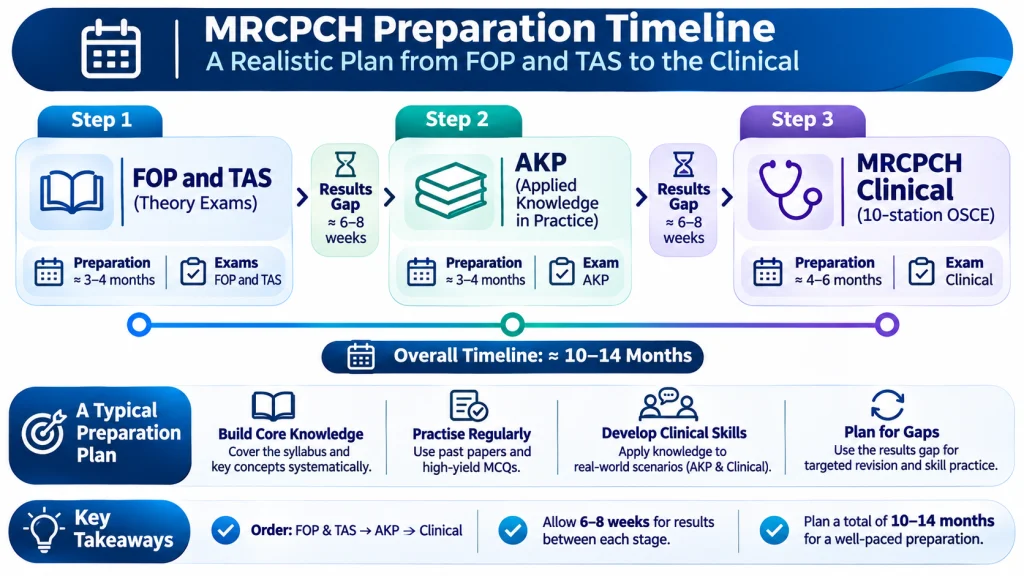
How long your MRCPCH preparation takes depends on your rota, your family commitments and how recently you studied for an exam. The table shows one realistic order for a working doctor; treat it as a starting point and stretch any block that feels rushed.
| Stage | Typical study block | Then |
| FOP and TAS | About 12 to 16 weeks | Sit both on the same day; results 6 to 7 weeks later |
| AKP | About 12 weeks | Results 6 to 7 weeks later |
| Clinical application | Apply once all three theory exams are passed | Places are allocated by priority, not first come, first served |
| Clinical preparation | Several months of practice with feedback | Sit at your allocated centre |
Theory diets run three times a year: January/February, May/June and September/October, with AKP before FOP and TAS. For 2027, FOP and TAS are on 17 February, 23 June and 13 October, and AKP is on 20 January, 26 May and 22 September. Applications for the February 2027 FOP and TAS open on Monday 30 November 2026 at 09:30 GMT. Our MRCPCH exam dates guide has every window.
Two things shape the long view of your MRCPCH exams. The first is the seven-year rule: the Clinical must be passed within seven years of passing all three theory exams.
The second is experience. For the Clinical, RCPCH strongly recommends at least 2.5 years of training from your graduation date and at least 12 months in posts involving acute paediatric care in the five years before the exam. If you are early in your career, you can start the theory now and let your experience catch up. The MRCPCH eligibility guide explains the detail.
Starting with FOP and TAS
FOP and TAS are a natural first step in MRCPCH preparation because they are sat together and test the base that AKP and the Clinical build on. FOP is a two-hour morning paper and TAS a two-hour afternoon paper, each with 100 single best answer questions.
Give yourself 12 to 16 weeks. Spend the first weeks mapping the syllabus and doing short timed sets to find your gaps, then work through systems with questions after each topic. TAS rewards understanding the science behind what you do on the ward, so do not leave it until the end. Our FOP and TAS preparation guide has full 12- and 16-week plans.
Moving on to AKP
Of the theory MRCPCH exams, AKP is the one closest to real clinical work. Two papers of 2 hours 30 minutes on the same day test whether you can apply knowledge to a particular child, so clinical reasoning matters as much as recall.
About 12 weeks of focused work suits a doctor working full time. Build a consistent method for single best answer questions, keep an error log of every wrong answer, and rehearse a full two-paper day before the exam. The MRCPCH AKP guide sets out a week-by-week plan.
Getting ready for the MRCPCH Clinical
The Clinical deserves the longest runway of all your MRCPCH exams, so start thinking about it while you are still sitting theory. It is a circuit of 10 scenarios or stations in a hospital, with trained examiners at each one; RCPCH does not set out station-by-station content on the pages we checked, so prepare broadly.
Places at overseas centres are allocated by priority, not first come, first served, and RCPCH says India, Pakistan, Egypt, Saudi Arabia and the UAE have very high demand. There is no Clinical centre in Kuwait or Bahrain, so doctors there sit theory locally and apply to a Clinical centre elsewhere. Apply as soon as your theory passes allow, and only one Clinical event can be applied for at a time.
Clinical skills improve fastest with someone watching. Practise full encounters, history, examination and explanation to a parent, with a senior colleague or study partner who will give honest feedback. Our MRCPCH Clinical exam guide covers the format and preparation in more depth.
Studying for the MRCPCH exams while working full time
Most of your MRCPCH preparation will happen around shifts, so build a plan that survives a bad week. Short daily sessions beat occasional long ones, because consistency is what moves knowledge into long-term memory.
Aim for a fixed weekly target, such as ten to twelve hours, and split it into blocks that fit your rota: an hour of questions after a day shift, a longer review on a day off. Keep a small set of questions on your phone for gaps between tasks. When nights or on-calls wipe out a week, do not try to make up every hour; simply restart the plan.
Use your clinical work as study. When you see a child with a condition on the syllabus, read about it that evening. Patients you have seen are far easier to remember than pages you have read, and it turns ward time into MRCPCH preparation without adding hours. Talk to your seniors early, too, because planned study leave around exam dates makes a real difference.
Guidelines, study groups and when a course helps
The MRCPCH exams are set by a UK college, so prepare around the UK approach to paediatric care. Where your local practice differs from UK guidance, learn both and answer the exam the UK way. Use the official RCPCH syllabus as your checklist, and prefer official guidance over summaries of it.
A small study group of two to four doctors sitting the same diet can keep your MRCPCH preparation on track. Agree a weekly topic, do questions separately, then meet to discuss the ones you disagreed on; explaining an answer out loud is one of the best tests of whether you understand it. For the Clinical, a partner is close to essential, because you need someone to play the parent and watch your examination. StudyMEDIC also shares exam-focused videos on its YouTube channel.
A course helps your MRCPCH preparation most when you need structure, regular question practice with explanations, or feedback you cannot get at work. StudyMRCPCH has courses for MRCPCH FOP and TAS, the MRCPCH AKP and the MRCPCH Clinical; see each course page for what it includes. Whatever you choose, the work of steady practice is still yours, and that is what carries you through.
Frequently asked questions
How long does MRCPCH preparation take?
For a working doctor, the whole route is likely to take more than a year: a few months for FOP and TAS, around 12 weeks for AKP, then time to secure a Clinical place and prepare for it.
In what order should I sit the MRCPCH exams?
The three theory exams can be taken in any order, but all three must be passed before you apply for the Clinical. Starting with FOP and TAS works well because they are sat on the same day.
Can I prepare for the MRCPCH exams while working full time?
Yes. Plan a fixed weekly target, study in short regular blocks around your rota, and use the patients you see as revision.
Do I need experience before the theory exams?
RCPCH does not require a set amount of experience before the theory exams. For the Clinical, it strongly recommends at least 2.5 years of training from graduation and 12 months in acute paediatric posts in the five years before.
Is there a pass mark I should aim for?
No fixed theory pass mark is published, because the theory exams are standard-set using the Modified Angoff method. The Clinical pass mark is set out in our results guide.
Are study groups useful for MRCPCH preparation?
A small group sitting the same diet helps with motivation and discussion of difficult questions. For the Clinical, a practice partner is very valuable.
Talk to our MRCPCH team: contact StudyMRCPCH to plan your route, or see the MRCPCH FOP and TAS course page for what it includes.
Related guides: FOP and TAS preparation · MRCPCH AKP · MRCPCH Clinical exam · MRCPCH results
Sources: RCPCH: about MRCPCH · RCPCH: theory exams structure and syllabi · RCPCH: theory exam upcoming dates · RCPCH: MRCPCH Clinical