
The MRCPCH AKP (Applied Knowledge in Practice) is a computer-based theory exam of two papers sat on the same day, each lasting 2 hours 30 minutes, with 120 single best answer questions in total. Preparing well means about 12 weeks of steady work built on clinical reasoning rather than memorised lists, with timed practice of whole papers towards the end.
This guide covers the AKP format and 2027 dates, a 12-week study plan, a method for clinical reasoning questions, how to handle clinical data, and the mistakes worth avoiding.
Table of Contents
What the MRCPCH AKP exam looks like
AKP is one of three MRCPCH theory exams, alongside Foundation of Practice (FOP) and Theory and Science (TAS). The three can be taken in any order, and all three must be passed before you can apply for the MRCPCH Clinical.
| Feature | AKP |
| Papers | Two, on the same day |
| Time | 2 hours 30 minutes per paper |
| Questions | 120 in total, 60 per paper |
| Question type | Single best answer (SBA) |
| Delivery | Computer-based, normally at a test centre |
| Pass mark | Standard-set using the Modified Angoff method; no fixed number published |
Remote invigilation is available if you have no local test centre, live more than 200 miles from one, or have an approved adjustment. It is not available in the UAE. RCPCH does not publish a pass mark, so ignore anyone who quotes one; aim to be safe across the whole syllabus instead.
The name tells you what the exam values. Applied knowledge means taking what you know and using it for a particular child in front of you, which is why your AKP preparation should look different from revising facts for FOP. The official RCPCH syllabi (v3, February 2026) should be your map for what to cover.
When to sit AKP: 2027 dates and fees
Theory diets run three times a year, and in each one the MRCPCH AKP comes before FOP and TAS. These are the 2027 MRCPCH AKP diets as RCPCH lists them.
| Diet | Exam date | Applications open | Close (online invigilation) | Close (test centres) |
| AKP 2027.1 | Wed 20 Jan 2027 | Staggered from Mon 2 Nov 2026 | Check RCPCH | Check RCPCH |
| AKP 2027.2 | Wed 26 May 2027 | Mon 8 Mar 2027, 09:30 BST | Fri 12 Mar 2027 | Mon 15 Mar 2027 |
| AKP 2027.3 | Wed 22 Sep 2027 | Mon 5 Jul 2027, 09:30 BST | Fri 9 Jul 2027 | Mon 12 Jul 2027 |
For January 2027, applications opened by region: 2 November 2026 for the Gulf countries, Egypt, Jordan, the UK and ROI and online candidates, 3 November 2026 for India, Pakistan and Sri Lanka, and 4 November 2026 for Malaysia, Singapore and Trinidad. Check RCPCH for the closing date. Application windows are short, so put the opening date in your calendar the day you decide to sit.
The AKP fee is £659 (UK) or £929 (international) in 2026, rising to £680 and £960 in 2027. Fees are charged in pounds sterling, so the local cost depends on the exchange rate and card charges on the day you pay. Our MRCPCH exam dates and MRCPCH fees guides have the full tables.
A 12-week MRCPCH AKP study plan
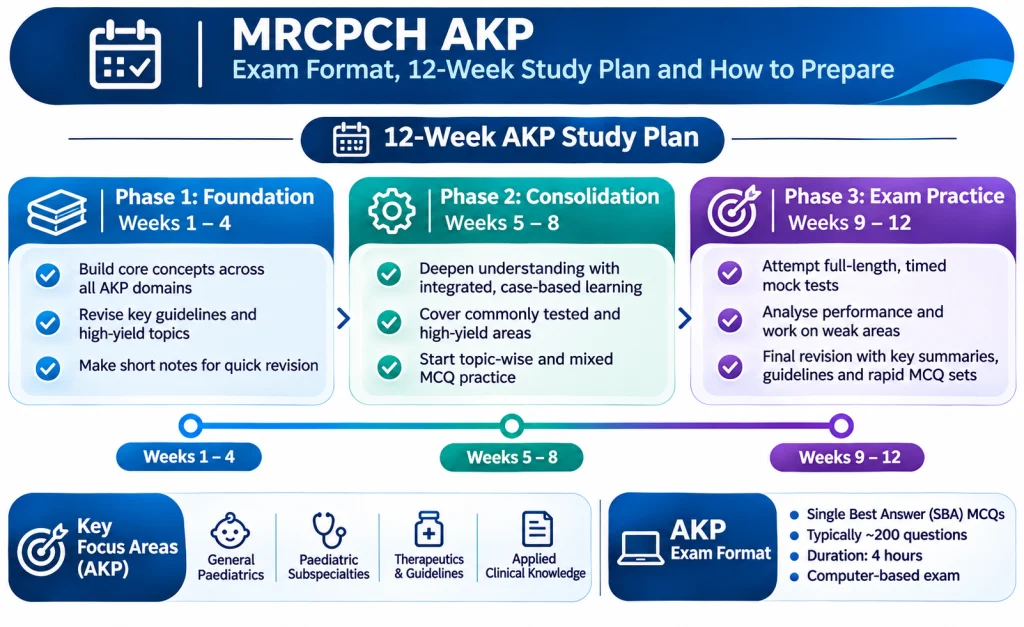
Twelve weeks of AKP preparation suits a doctor working full time who can protect about ten to twelve hours a week. Adjust the length to your rota, but keep the three phases: build, consolidate, then rehearse.
| Weeks | Focus | What to do |
| 1 to 2 | Baseline and plan | Read the syllabus, sit a short timed set, list weak areas |
| 3 to 5 | First half of the syllabus | Work through syllabus areas in the order you choose; questions after each topic |
| 6 to 8 | Remaining syllabus areas | Cover the rest of the RCPCH syllabus, weakest areas first |
| 9 to 10 | Consolidation | Mixed question sets, review every wrong answer, revisit weak areas |
| 11 | Full papers | Two timed 2.5-hour papers on the same day, at least once |
| 12 | Light review | Notes from your error log, sleep, logistics |
The most valuable tool in this plan is an error log. Every time you get a question wrong, write one line on why: missing knowledge, misreading the stem, or choosing a good answer over the best one. By week nine, the log tells you exactly where to spend your remaining time.
Do not skip the full-paper rehearsal in week 11. Sitting two papers of 2 hours 30 minutes on one day is tiring, and concentration in the second paper is a skill you can train.
Clinical reasoning: how to approach AKP questions
Strong MRCPCH AKP answers come from a consistent method, not from recognising a fact. Single best answer questions often have several plausible options, and the exam rewards the one that best fits this child, at this moment.
Try the same four steps on every stem. First, read the last line so you know what is being asked: diagnosis, next investigation, or management. Second, pick out the age, the setting and the key findings.
Third, decide on your answer before you look at the options. Fourth, compare your answer with the options and ask what makes the best one better than the second best.
Age changes everything in paediatrics. The same symptom means different things in a neonate, a toddler and an adolescent, so train yourself to note the age before anything else. Setting matters too: what you would do first in an emergency department may differ from what you would arrange in clinic.
Handling clinical data and investigations
RCPCH does not break the AKP papers down by question style on the pages we checked, so prepare for clinical information presented in different ways. The habit that helps is reading data systematically, every time, rather than hunting for the abnormal value.
When a stem gives you results, check them against the child’s age before deciding what is abnormal, because paediatric reference ranges shift as children grow. Then link the result back to the clinical picture: an investigation is only useful if it changes what you would do. Practising this on the wards, with real results from your own patients, is excellent AKP preparation because it costs no extra study time.
If you want structured support for this stage, StudyMRCPCH has an MRCPCH AKP course; see the course page for what it includes.
Common mistakes in AKP preparation
Lost marks in the MRCPCH AKP often trace back to a handful of habits. Each is fixable once you notice it.
| Mistake | Better approach |
| Reading notes without doing questions | Do questions from week three onwards, after each topic |
| Reviewing only the answers you got wrong | Also check correct answers you guessed |
| Ignoring the syllabus | Use the RCPCH syllabus as your checklist |
| Never sitting a full timed paper | Rehearse two papers in one day before the exam |
| Choosing a correct answer, not the best one | Ask why the best option beats the runner-up |
| Relying on local practice alone | Check UK guidance where it differs from local practice |
The last point deserves a word if you trained in India or the Gulf. Your clinical experience is a real asset, but where local practice differs from UK guidance, answer the way a UK paediatrician would. Ask colleagues who have sat the exam which resources they found closest to the questions, and keep to official sources where you can.
Exam day and what comes after
On the day of your MRCPCH AKP, pace yourself at roughly two and a half minutes per question in each paper, and flag anything that stalls you rather than losing time on it. Use the break between papers to eat, drink and reset; do not spend it discussing questions with other candidates.
Results appear in your RCPCH online account six to seven weeks after the exam, with a detailed breakdown by email about a week later. Our MRCPCH results guide explains what to do next. You have up to six attempts at each component, counted from 1 September 2024, and an attempt counts once you start the exam.
If AKP is your last theory exam, a pass means you can apply for the Clinical. The MRCPCH Clinical exam guide explains the format, and the FOP and TAS preparation guide covers the other two theory papers if you still need them.
Frequently asked questions
How many questions are in the MRCPCH AKP?
There are 120 single best answer questions in total, split into two papers of 60. Each paper lasts 2 hours 30 minutes and both are sat on the same day.
What is the AKP pass mark?
RCPCH does not publish one. The theory exams are standard-set using the Modified Angoff method, so aim for secure knowledge across the whole syllabus.
Can I sit the MRCPCH AKP before FOP and TAS?
Yes. The three theory exams can be taken in any order, but all three must be passed before you apply for the MRCPCH Clinical.
How long should AKP preparation take?
About 12 weeks suits a working doctor with ten to twelve hours a week to study. Allow longer if your rota is heavy or you are new to UK-style questions.
Can I take the MRCPCH AKP online?
Remote invigilation is available if you have no local test centre, live more than 200 miles from one, or have an approved adjustment. It is not available in the UAE.
When is the next MRCPCH AKP exam?
The 2027 diets are on 20 January, 26 May and 22 September 2027. Applications for May open on 8 March 2027 at 09:30 BST.
Talk to our MRCPCH team: contact StudyMRCPCH for help planning your AKP, or see the MRCPCH AKP course page for what it includes.
Related guides: MRCPCH exam dates · FOP and TAS preparation · MRCPCH preparation · MRCPCH results
Sources: RCPCH: theory exams structure and syllabi · RCPCH: theory exams · RCPCH: theory exam upcoming dates · RCPCH: exam regulations