
Plan your FOP and TAS preparation over 12 to 16 weeks of steady work if you are in full-time clinical practice, built around the official syllabus, daily single best answer (SBA) practice and timed mock papers. Because FOP and TAS are sat on the same day, two hours each, your plan has to cover both papers in parallel rather than one after the other.
This guide covers 12- and 16-week plans, how to handle both papers in one day, SBA technique, how to use the syllabus and question banks well, and the mistakes worth avoiding.
Table of Contents
What FOP and TAS preparation needs to cover
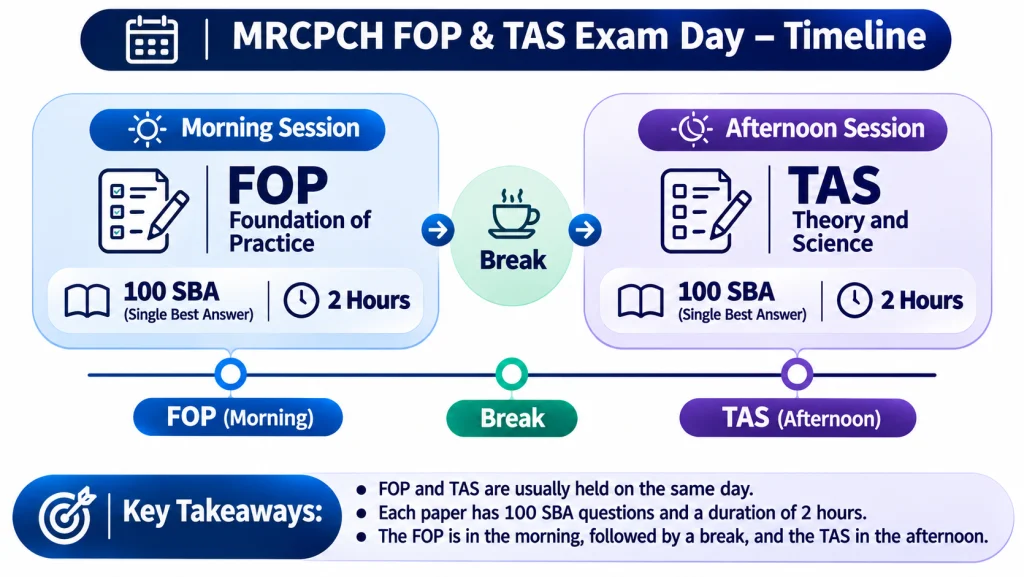
You are preparing for two computer-based papers sat on the same day: FOP in the morning and TAS in the afternoon, each with 100 single best answer questions in two hours. Both are standard-set using the Modified Angoff method, and RCPCH does not publish a fixed pass mark, so aim for broad, secure knowledge rather than a target score.
| Paper | Session | Questions | Time |
| FOP | Morning | 100 SBA | 2 hours |
| TAS | Afternoon | 100 SBA | 2 hours |
The scope of each paper is set out in the RCPCH syllabi document, currently version 3 from February 2026, on the RCPCH theory exams structure and syllabi page. Download it before you start and use it as your checklist. Our guide to the MRCPCH FOP and TAS exam format explains the structure in more detail.
A 12-week study plan
A 12-week study plan suits you if you already have a reasonable base in paediatrics and can protect around 10 to 12 hours a week. It also fits the next diet neatly: the FOP and TAS 2027.1 application window opens on Monday 30 November 2026, and the exam is on Wednesday 17 February 2027.
| Weeks | Focus | Weekly pattern |
| 1 to 2 | Read the syllabus, take a baseline mock, list weak areas | 5 short sessions, 1 long session |
| 3 to 6 | Topic-by-topic review for both papers, untimed questions after each topic | 40 to 60 questions a day on working days |
| 7 to 9 | Mixed timed blocks, focused revision of weak areas | 2 timed blocks of 50 questions each week |
| 10 to 11 | Full mock papers in exam conditions, morning and afternoon | 1 full mock day a week, review the next day |
| 12 | Light review of notes and errors, rest before the exam | Short sessions only |
The key is the baseline mock in week one. It tells you where your FOP and TAS preparation should spend time, and it stops you re-reading topics you already know.
A 16-week plan for busy doctors
A 16-week plan is the safer choice if you work long rotas, are returning to study after a gap, or find basic science harder than clinical knowledge. The extra four weeks go into topic review, where time pressure does the most damage.
| Weeks | Focus | Weekly pattern |
| 1 to 2 | Syllabus review and baseline mock | 4 to 5 sessions |
| 3 to 9 | Topic review alternating between FOP and TAS areas, with question practice after each topic | 30 to 50 questions a day |
| 10 to 12 | Mixed timed blocks, error log review | 2 to 3 timed blocks a week |
| 13 to 15 | Full mock days, morning and afternoon papers back to back | 1 mock day a week |
| 16 | Consolidation and rest | Light review |
Both tables are guides, not rules. If your mock scores are rising steadily, keep going; if they stall, slow down and look at the kind of questions you are getting wrong.
Sitting both papers on the same day
Sitting FOP and TAS on one day is mainly a stamina problem, so your FOP and TAS preparation should include full rehearsal days. Two hours in the morning, a break, then two more hours in the afternoon is tiring in a way that a single 50-question block never is.
From about the halfway point of your plan, run at least three full mock days: one paper in the morning, one in the afternoon, timed, with only the break you will get on the day. Notice when your concentration drops and practise a routine for the break: food, water, a short walk and no discussion of answers.
As part of your FOP and TAS preparation, decide in advance whether you will sit at a test centre or by remote invigilation, if you qualify. Remote invigilation is available if you have no local test centre, live more than 200 miles from one or have an approved adjustment, and it is not offered in the UAE. Rehearse in conditions close to the real setting.
SBA technique that saves marks
Strong SBA technique is about reading the question properly and choosing the best answer, not just a correct one. Read the final line first so you know what is being asked, then read the stem looking for the details that change the answer: age, timing, severity and what has already been tried.
Try to answer before looking at the options. If your answer is there, check the others quickly and move on. If it is not, eliminate options that are clearly wrong and choose between the rest on the most specific detail in the stem.
Watch your pace. With 100 questions in 120 minutes, you have a little over a minute each, which leaves some time at the end for flagged items. Flag anything that takes longer than two minutes, move on, and come back at the end.
Question practice that actually works
Question practice works best when you treat every wrong answer as a lesson. After each block, write down why you got a question wrong: a knowledge gap, a misread stem or a poor choice between two plausible options. Patterns appear within a couple of weeks.
Volume matters less than review. Doing fewer questions and understanding each mistake is more useful than racing through hundreds and checking only your score. Revisit your error log every week and re-test those topics.
Mix sources sensibly and keep the syllabus beside you throughout your FOP and TAS preparation, so your question practice covers every area rather than the topics a bank happens to favour. If you would like a structured route, StudyMRCPCH has an MRCPCH FOP and TAS course; see the course page for what it includes.
Common mistakes in FOP and TAS preparation
One trap to watch is spending too long reading and too little time answering questions under time pressure. Reading feels productive, but the exam rewards applying knowledge quickly.
Other mistakes are easy to avoid once you know them. Some doctors prepare for FOP and neglect the basic science side of TAS, or the other way round. Some skip full mock days and then struggle with fatigue in the afternoon. Others book late and miss the short application window, or ignore the syllabus and rely on memory of what came up for a friend.
Finally, do not let one disappointing mock derail your study plan. Mock scores move around from week to week, and the trend over a month tells you far more than a single paper. Look at what went wrong, adjust the next two weeks, and carry on.
Results appear in your online RCPCH account six to seven weeks after the exam, so plan your next step, whether that is AKP or a resit, before results day. Our MRCPCH exam dates guide has the 2027 calendar.
Frequently asked questions
How long should FOP and TAS preparation take?
Plan for 12 to 16 weeks alongside clinical work. Choose 16 weeks if your rota is heavy or basic science is a weak area.
Can I sit FOP and TAS on different days?
Not within one diet: FOP is the morning paper and TAS the afternoon paper on the same day. You can book a single paper, though, and sit the other at a later diet.
How many questions are in each paper?
Each paper has 100 single best answer questions in two hours.
What is the pass mark for FOP and TAS?
RCPCH does not publish a fixed pass mark. Both papers are standard-set using the Modified Angoff method.
When is the next FOP and TAS exam?
The next diet is on Wednesday 17 February 2027. Applications open on Monday 30 November 2026 at 09:30 GMT and close in early December.
Where do I find the official syllabus?
The RCPCH syllabi document, version 3 from February 2026, is on the RCPCH theory exams structure and syllabi page.
Talk to our MRCPCH team at StudyMRCPCH about your study plan, or see the MRCPCH FOP and TAS course page for what it includes.
Related guides:
- MRCPCH FOP and TAS exam format
- MRCPCH exam dates for 2027
- MRCPCH AKP preparation
- MRCPCH fees for 2026 and 2027
Sources: