
The MRCPCH Clinical exam is the final component of MRCPCH: a circuit of 10 scenarios or stations in a hospital, each with trained examiners, and you need 62 out of 82 to pass. You can apply only after passing all three theory exams (FOP, TAS and AKP), and you must pass it within seven years of passing all three theory exams.
This guide covers the format, the pass mark, the experience RCPCH recommends, the seven-year rule, centres, results and a practical approach to preparing the core skills it tests.
Table of Contents
What the MRCPCH Clinical exam involves
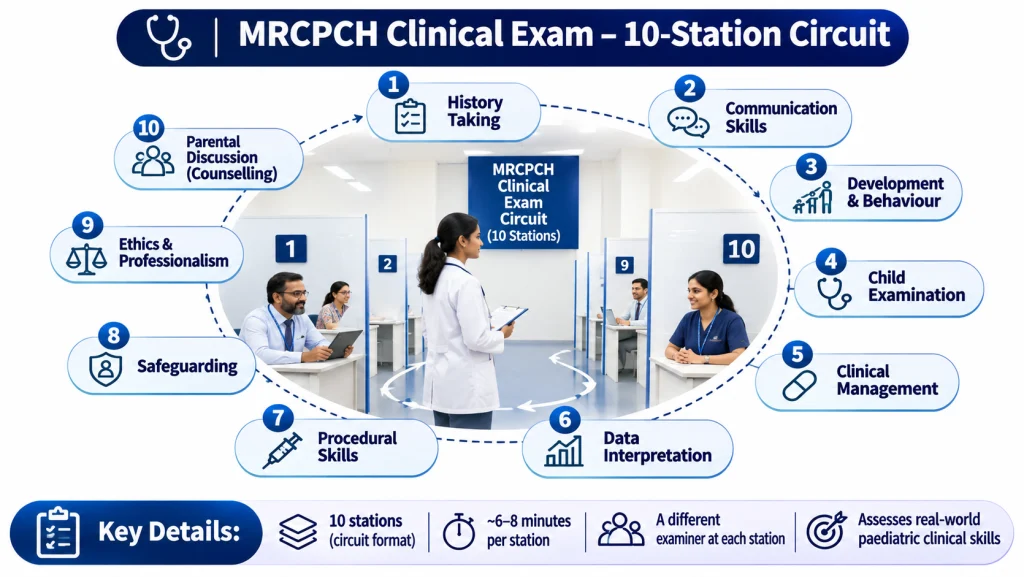
It is taken in a hospital as a circuit of 10 scenarios or stations, with trained examiners at each one. Where the theory papers test knowledge on a screen, the Clinical tests your clinical skills in front of trained examiners.
In the UK, sessions run in the morning from 10:00 to 12:30 or in the afternoon from 14:00 to 16:30. RCPCH advises you to plan for about 4.5 hours at the centre. Overseas times vary by centre and are given in your admission letter.
RCPCH does not publish a fixed station-by-station breakdown that we could verify, so be wary of anyone who promises you an exact list. What you can rely on is the overall shape: ten stations, trained examiners and a circuit you move around in turn. The RCPCH MRCPCH Clinical page has the official details for each centre.
Pass mark and what a low score means
The pass mark for the MRCPCH Clinical exam is 62 out of 82. If you score 52 or below, you cannot sit the next diet, which gives you time to rebuild before trying again.
Think of that rule as a signal rather than a penalty. If your score is well below the pass mark, treat it as a prompt to revisit core clinical method, and use the enforced gap to get structured feedback.
| Score | What it means |
| 62 to 82 | Pass |
| 53 to 61 | Fail; the next-diet restriction does not apply |
| 52 or below | Fail; you cannot sit the next diet |
Each start counts as one of your six attempts at the MRCPCH Clinical exam. Not attending does not count as an attempt.
Eligibility and the seven-year rule
You must pass FOP, TAS and AKP before you can apply for the MRCPCH Clinical exam. You also need a primary medical qualification acceptable for GMC registration, as for every MRCPCH exam.
RCPCH strongly recommends at least 2.5 years of training from the graduation date on your medical degree, and at least 12 months in posts involving acute paediatric care in the five years before the exam. These are recommendations, not requirements, but they signal the level of hands-on experience RCPCH expects you to bring. If you are short of acute paediatric time, building it before you apply is the most useful Clinical preparation you can do.
The seven-year rule matters too. The Clinical must be passed within seven years of passing all three theory exams, and at least one theory pass must be within the last seven years to be eligible.
If the period runs out without a Clinical pass, you re-sit AKP and the seven years restart from the new AKP pass. Exceptions may be granted on application. Our MRCPCH eligibility guide covers the full rules on attempts and timing.
Centres, places and fees
For 2027, RCPCH lists MRCPCH Clinical exam dates in Ahmedabad and Navi Mumbai in India, Jeddah in Saudi Arabia, Muscat in Oman and Doha in Qatar, with UAE dates still to be confirmed and three UK diets. There is no Clinical centre in Kuwait or Bahrain, so doctors working there apply to a centre elsewhere.
Places are not first come, first served. Overseas centres give priority to doctors working in the host country who are nearing the end of their seven-year period, then work down a published order. You can apply for only one Clinical event at a time, and unplaced candidates go on a waitlist with offers possible up to two weeks before the exam.
RCPCH says India, Pakistan, Egypt, Saudi Arabia and the UAE have very high demand, and applicants not working in those regions are unlikely to be prioritised there. See our guide to Clinical centres in India and the Gulf for dates and allocation, and the MRCPCH fees guide for the fee at each centre. RCPCH asks for payment only after a place is offered.
Results after the Clinical
Results for the MRCPCH Clinical exam appear in your online RCPCH account six to seven weeks after the exam, and a detailed breakdown is emailed about a week later. RCPCH does not give results by phone, post or in person.
Use the breakdown well. Whether you pass the MRCPCH Clinical exam or not, it shows where you dropped marks, and that is the most honest guide to what to practise next. Our MRCPCH results guide explains what to do after each exam, and the post on MRCPCH Clinical pass rates for overseas graduates looks at the published figures.
How to prepare for the MRCPCH Clinical exam skill by skill
The best Clinical preparation works on the core skills any paediatric clinical assessment draws on, rather than memorising lists of cases. Below is a practical way to organise your practice, written as advice rather than an official station list.
Examining children. Practise a structured, systematic examination until it is automatic, then practise presenting your findings out loud in a clear order. Examiners can only credit what they see and hear, so narrate your thinking concisely. Do this with children of different ages, because the approach to an infant is not the same as the approach to a teenager.
Talking with parents and young people. Many paediatric encounters are really conversations. Rehearse explaining a diagnosis, a plan or uncertainty in plain language, checking understanding and responding to worry. A UK-style consultation puts shared decisions and safety-netting at the centre, which may feel different if you trained in a busier, more directive system.
History and reasoning. Practise taking a focused history in a limited time and then summarising it with a differential and a plan. Time pressure is real across ten stations, so get used to working to a clock.
Practice with feedback. Solo reading will not get you through the MRCPCH Clinical exam. Practise with colleagues or seniors who will watch you and tell you honestly what an examiner would notice. Record yourself if you can, and repeat the stations you find hardest rather than the ones you enjoy.
Building a Clinical study routine
Start serious work for the MRCPCH Clinical exam once your theory is behind you, and keep your acute paediatric work going alongside it. Ward and clinic time is your best practice material: every child you assess is a chance to rehearse examination and explanation.
A simple weekly routine is two or three timed practice sessions with a partner, one session reviewing feedback, and steady reading of the clinical areas where your examination or explanation feels weakest. Keep the seven-year rule in mind, and plan around the dates at the centre where you are most likely to be prioritised.
If you want structured support, StudyMRCPCH has an MRCPCH Clinical course; see the course page for what it includes. You can also look at StudyMEDIC’s clinical programme in paediatrics.
Frequently asked questions
How many stations are in the MRCPCH Clinical exam?
It is a circuit of 10 scenarios or stations, held in a hospital, with trained examiners at each station.
What is the pass mark for the MRCPCH Clinical exam?
The pass mark is 62 out of 82. A score of 52 or below means you cannot sit the next diet.
How much experience do I need before the Clinical?
RCPCH strongly recommends at least 2.5 years of training from graduation and 12 months in acute paediatric posts in the previous five years. These are recommendations, not requirements.
How long do I have to pass the Clinical after theory?
You must pass it within seven years of passing all three theory exams. If that lapses, you re-sit AKP and the period restarts.
Can I apply to two Clinical centres at once?
No. You can apply for only one MRCPCH Clinical exam event at a time, and places are allocated by priority.
When do I get my Clinical results?
Results appear in your online RCPCH account six to seven weeks after the exam, with a detailed breakdown emailed about a week later.
Talk to our MRCPCH team at StudyMRCPCH about your Clinical plans, or see the MRCPCH Clinical course page for what it includes.
Related guides:
- MRCPCH Clinical centres in India and the Gulf
- MRCPCH Clinical pass rates for overseas graduates
- MRCPCH eligibility explained
- MRCPCH fees for 2026 and 2027
Sources: